The Nature of the Spirit and Soul
The Soul is immortal but created
It is essential to first understand the nature of the Soul, or anima, to distinguish it clearly from the Spirit. The Soul is a created entity, a product of the Demiurge or The One, designed to animate the material body and drive the evolutionary process of the universe. Unlike the Spirit, which is eternal and uncreated, the Soul is immortal but created; it belongs to the material order and is subject to the laws of time, evolution, and karma. The Soul is described as a subtle energy that diffuses throughout the microcosm, acting as a "double body" that sustains organic life and serves as the vehicle for the monad's manifestation in matter.
The function of the Soul is to evolve towards a final perfection or entelechy, known as the Manu Archetype. This evolution is achieved through the mechanism of metempsychosis or transmigration, where the soul moves from one incarnation to another, accumulating experience and refining itself according to the Plan of the Creator.
The Soul is deeply connected to the emotional sphere and the "warm blood" of the animal-man, or Pasu. It naturally seeks to fuse with its Creator, yearning for a state of pantheistic union often described in synarchic religions as Samadhi or Nirvana, which represents the final phagocytization of the individual consciousness into the One. For the Hyperborean Initiate, the Soul is not the true self but a prison or a structure that must be conquered and transcended to liberate the captive Spirit.
The Rational Mind
The Labyrinth of the Conscious Subject
The Mind, within this framework, is not a simple entity but a complex psychic structure that serves as the manifestation of the Soul. It is organized into three distinct "subjects" or modes of operation: the rational subject, the cultural subject, and the conscious subject. The rational subject operates within the brain or archetypal memory, processing information through logic and reason to ensure survival and adaptation to the world. This rational mind is constructed to interpret the "design" of external entities, translating the world of the Demiurge into concepts that the individual can understand and assimilate.
The Mind constructs a cultural structure and a schema-of-self (the ego of the Pasu), which is essentially a historical record of the individual's experiences within the material world. This structure acts as a labyrinth of meaning, filled with symbols, myths, and cultural premises that condition the individual's perception of reality. The danger for the spiritual seeker lies in the fact that the conscious subject—what we usually think of as our "waking self"—is inextricably linked to this cultural and rational machinery. It operates within transcendent time, the time of the world, and is designed to keep the individual synchronized with the cosmic plan of the Demiurge. Therefore, the thoughts and reasonings of the ordinary mind are often traps that prevent the awakening of the true Spirit, keeping the individual lost in the Great Deception of culture and logic.
The Uncreated Spirit
The Hostile Guest and the True Self
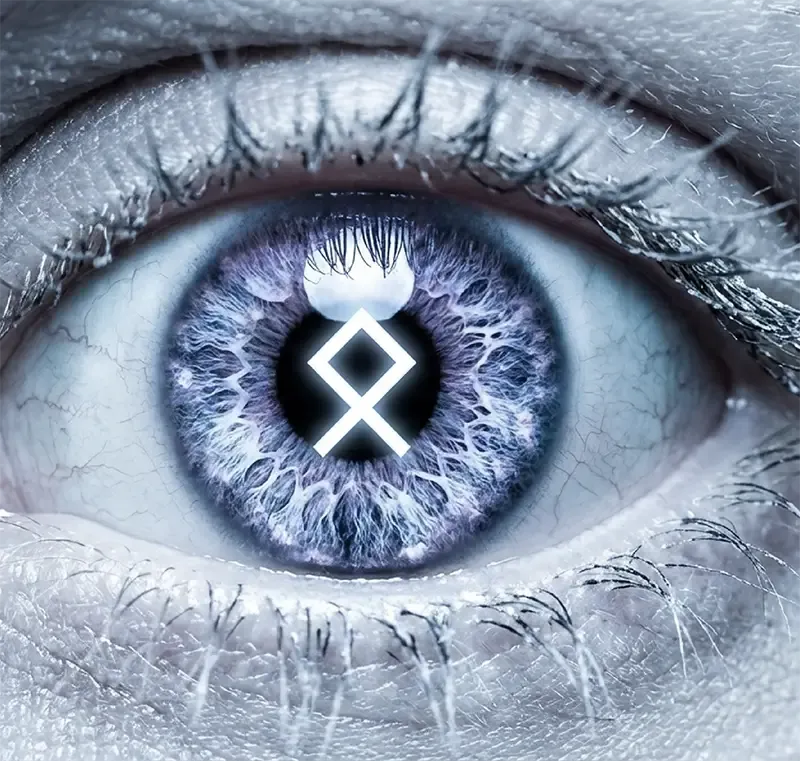
The Spirit, or Vril, is the absolute opposite of the created Soul and Mind. It is an uncreated, eternal entity that originates from a world outside the material universe, known as Hyperborea or the Origin. The Spirit is a "stranger" in this world, trapped or enchained to the animal-man (Pasu) through a primordial betrayal by the Traitor Siddhas. While the Soul belongs to the world and loves it, the Spirit is essentially hostile to the material order because it recognizes, instinctively, that it is a prisoner in a universe of illusion and suffering.
In the sleeping man, the Spirit is confused and lost, mingled with the Soul. However, its presence is manifested as the Ego or "I". This True Self is not the psychological personality constructed by the mind, but a reflection of the Infinite Spirit trapped in matter. The Spirit is described analogically as a sphere that has been "reverted" or turned inside out, causing it to lose its orientation and forget its divine origin. The awakened Spirit possesses Will and Valor, qualities that are not derived from the energetic evolution of the cosmos but are reflections of its own eternal nature. The goal of the Spirit is not to evolve or merge with the cosmos, but to achieve Kaivalya, absolute separation and independence, recovering its lost totality and returning to the Unknowable God.
The Uncreated Spirit and the Demiurgic Soul
The fundamental differences between the Spirit and the soul.
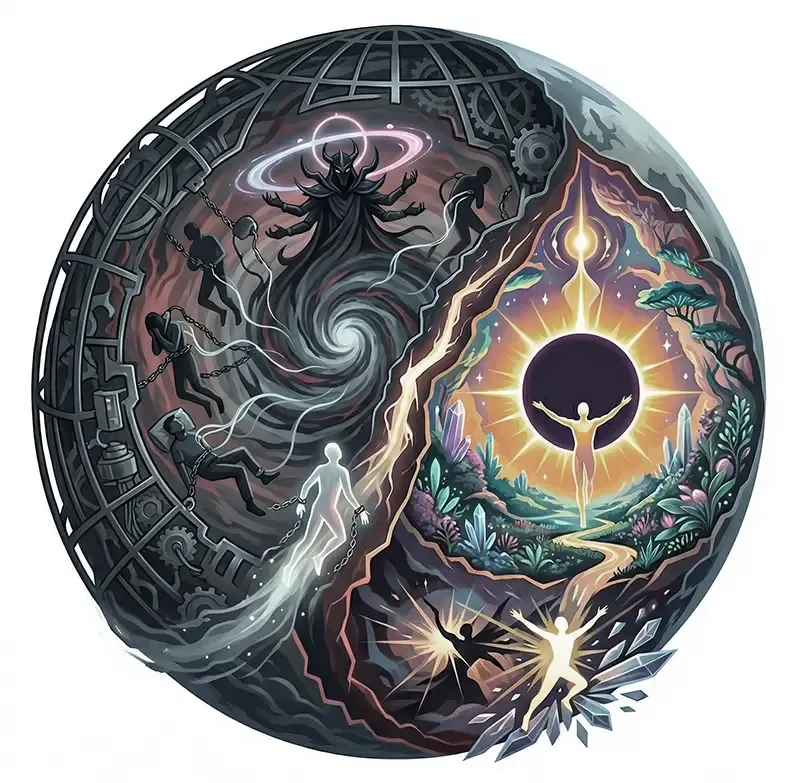
Based on the "The Pleroma: The Sphere of the Spirit" text, the Spirit and the soul are fundamentally opposing entities with distinct origins, natures, and destinies. The core difference lies in the fact that the Spirit is Uncreated, while the soul is a created construct of the material universe.
Here are the fundamental differences:
1. Origin and Ownership
-
The Spirit: Originates from the Pleroma (the Sphere of the Spirit), a domain of the Unknowable God that exists absolutely outside the material universe. It is "Uncreated," meaning it was not made by the creator of this world (the Demiurge).
-
The Soul: Is created by and belongs to the Demiurge. It is an intrinsic part of the material cosmic order and is designed to function within the "Plan" of the Creator.
2. Nature and Law
-
The Spirit: Its true nature is "totally alien to the material world" and belongs to a trans-infinite order of eternity and perfection. By nature, it is free from the determinations of the created order, though it is currently entrapped.
-
The Soul: Is subject to the laws of the created universe, specifically the Law of Evolution and reincarnation. It is bound by time, entropy, and mechanical laws.
3. The Great Deception
-
The Spirit: Is a "prisoner" and a "stranger" within the universe. It has been chained to the animal-man (the Pasu) to serve as the evolutionary motor for the Demiurge's creation.
-
The Soul: Acts as a mechanism of entrapment. The Demiurge uses the soul and its psychological structures to "mesmerize" the Spirit, forcing the Spirit to confuse its identity with the soul.
4. Ultimate Destiny
-
The Spirit: Seeks Kaivalya, or absolute separation. Its goal is to separate from the soul, recover its individuality ("Absolute Personality"), and return to the Pleroma. It fights to avoid being consumed by the Creator.
-
The Soul: Seeks fusion. It is driven to evolve and eventually merge with the Creator (the Demiurge) at the end of time, a process described in the text as "monstrous phagocitization" or absorption.
In summary, the soul is a tool of the Demiurge used to keep the Spirit asleep, while the Spirit is the eternal, uncreated Self that must reject the soul to regain its freedom.
The Conflict and Liberation
Isolating the Self from the Subject
The fundamental drama of human existence is the confusion between these three elements: the Spirit (Ego) is submerged in the Mind (Conscious Subject) which is animated by the Soul. The "Lost Virya" is the individual who believes that his psychological personality (Mind/Soul) is his true self, unaware that he is actually an Eternal Spirit chained to that structure. To achieve liberation, a war must be waged. The awakened Virya must learn to distinguish between the voice of the Spirit (Blood Memory) and the voice of the Soul (Cultural/Rational premises).
This process involves a technique known as Strategic Opposition or the Archemonic Technique. The individual must construct an "interior fortress" to isolate the Ego from the conscious subject. By doing so, the Virya separates his Will from the desires and mechanical conditioning of the Soul and Mind. He must become a Man of Stone, possessing a "heart of ice" to resist the emotional seductions of the Soul and a "will of fire" to break the chains of the Mind. The ultimate goal is to reverse the "reversion" of the Spirit, reorienting the Vultus Spiritus (spiritual face) towards the Selbst (the absolute center of the Spirit) and away from the illusion of the material world. This effectively means "killing" the influence of the immortal Soul over the Ego to regain the immortality of the Spirit and escape the eternal cycle of rebirth.